
Mountain Gold: Tortelli di Zucca
Updated: Jan 25
Some dishes become part of your story even if they never appeared on your own family table. Tortelli di zucca is one of those for me.
Jump to Recipe. Jump to Wine Pairing.
It is deeply rooted in the cooking of Parma and the surrounding countryside of the Alta Val Taro, the same mountainous area my family comes from. In this part of Emilia Romagna, pumpkin filled pasta is not a novelty or a seasonal trend. It is simply part of the landscape, part of the rhythm of how people cook and eat. You see it on menus, you hear it discussed casually, and you grow up understanding that this is food that belongs here.
Historically, tortelli di zucca grew out of practicality. Squash stored well through the winter months, dairy was plentiful, and pasta was a way to turn those ingredients into something nourishing and celebratory at the same time. Over time, regional variations emerged. In nearby Mantova, the filling often leans sweet, sometimes including crushed amaretti cookies, mostaccino, or a hint of sugar. That version has its place and its devotees.
For me, though, that sweetness has never quite landed. While I appreciate the tradition, I find that amaretti can push the filling too far, tipping it away from the savory depth I love. I prefer a more restrained approach, one that lets the pumpkin speak for itself, supported by ricotta, Parmigiano Reggiano, and nutmeg rather than overshadowed by sweetness. It feels more honest to the way I understand this region and its cooking.
My grandmother never made tortelli di zucca. That is true. But not every inherited dish comes directly from a parent or grandparent’s kitchen. Some come from place. From geography. From knowing where your people are from and recognizing the foods that define that landscape. This is one of those dishes for me.
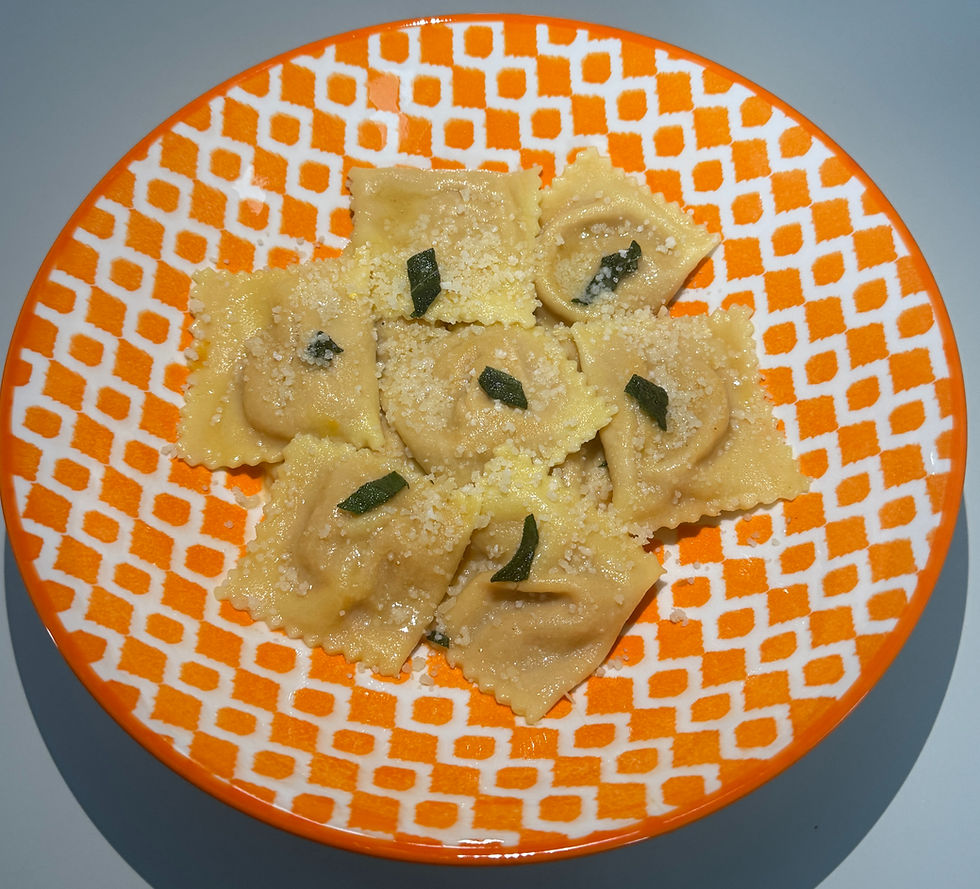
Served simply with butter and sage, tortelli di zucca is quietly powerful. Rich but balanced. Comforting without being heavy. It is a reminder that northern Italian cooking is often about restraint, letting ingredients work together rather than competing for attention.
Tortelli di Zucca
Serves 8 (makes approximately 140 ravioli, 1½–2 inches)
The Pasta Fresca:
630 g imported “00” Flour
7 large eggs (room temp.)
Rimacinata Semolina flour
The Filling:
3 sugar pumpkins (preferred) or 3 (15 oz. / 425 g) cans pumpkin puree
340 g whole milk ricotta (12 oz.)
160 g grated Parmigiano Reggiano (5.5 oz.)
½ of a freshly grated nutmeg
salt & pepper q.b.
The Sauce:
6 Tbs. of really good quality butter
10 sage leaves, slivered
lots of grated Parmigiano Reggiano
Method:
Make the Dough:
Mound the flour on a clean work surface and form a well in the center.
Crack the eggs into the well. Using a fork, gently whisk the eggs, gradually pulling flour in from the sides until a shaggy dough forms. Switch to your hands and knead until smooth and elastic, about 8 to 10 minutes.
Wrap tightly and let rest at room temperature for at least 30 minutes before rolling.
Make the Filling:
Preheat overn to 400° F.
Halve the pumpkins and remove the seeds. Place cut side down on a parchment lined pan and roast until completely tender, about 45 to 60 minutes. If using canned pumpkin, be sure to drain it.
Allow to cool slightly, then scoop out the flesh and purée until smooth. Let the purée drain in a fine mesh sieve or cheesecloth to remove excess moisture before using. Make sure to drain the ricotta as well.
Combine all filling ingredients and season with salt and pepper.
Form the Tortelli:
Divide the dough into 6 pieces. Keep the pieces you are not working with covered, so they don’t dry out.
Starting with the widest setting on your pasta machine, gradually roll the dough through each number until it reaches the second smallest setting. Dust with semolina flour as needed to prevent sticking. You should be able to see your hand through it.
I use a pastry bag to pipe my filling, but you use a spoon if you prefer. Cut the strip in half lengthwise, pipe filling along the middle of the strip. Fold it over itself and press dough around the filling to remove as much air as possible (a small wooden dowel works great).
Cut with a pastry wheel and transfer in a single layer to a sheet dusted with semolina.

Put it all Together:
Bring a large pot of salted water to a boil. When the water is boiling, heat a large pan over medium-low heat.
Drop the tortelli in the water and boil for about 4 minutes.
While the tortelli are cooking, add the butter to a wide pan set over medium-low heat. Let the butter melt gently, swirling the pan occasionally. As it cooks, it will foam and bubble while the water evaporates.
When the bubbling quiets and the butter smells warm and nutty, remove the pan from the heat immediately. Add the sage leaves and let them steep in the hot butter for about 30 seconds, just until fragrant.
Transfer the cooked tortelli directly into the pan with a ladle or two of pasta water and toss gently to coat.
Serve immediately, finished with plenty of Parmigiano Reggiano.
Featured Wine
For tortelli di zucca, I turned to Pieropan Soave Classico, a wine that has long set the benchmark for Soave and for Garganega as a grape. Pieropan is one of the historic producers of the region, and their wines have played a major role in redefining Soave from a simple everyday white into a serious expression of place.

Soave is made primarily from Garganega, a variety that thrives in the volcanic soils of the hills east of Verona. Those soils give the wines a distinctive mineral edge, along with notes of citrus, stone fruit, almond, and sometimes a faint herbal bitterness. It is that bitterness, subtle but grounding, that makes Garganega such a natural partner for pumpkin. It reins in sweetness and keeps the dish firmly in savory territory.
Pieropan’s approach is restrained and traditional. Fermentations are clean, oak is used sparingly or not at all depending on the cuvée, and the focus remains on freshness, balance, and longevity rather than power. The resulting wine has bright acidity and quiet complexity, qualities that work beautifully with butter and sage, while allowing the pumpkin, ricotta, Parmigiano, and nutmeg to stay front and center.
What I love most about this pairing is how natural it feels. Northern Italian food often relies on subtle contrasts rather than bold gestures, and Soave fits seamlessly into that philosophy. It supports the dish without announcing itself, making each bite feel lighter and more complete.
Jump back to recipe.


Comments